
What I Tested While Building Davetiyem.com
How I turned a family background in printing into a digital invitation product for the Turkish market.
- Product
- Growth
- Marketing
- Case Study
Davetiyem did not start with a startup pitch deck.
My family has been in the invitation and printing business for around 30 years. I worked there for two years myself. I have not been directly involved with the family business for the last six years; since then, I have focused on software, digital products, and growth marketing.
But whenever I spoke to my family, I kept hearing a similar sentence:
“This season is quieter than the last one.”
The economy is part of the reason. But the invitation process itself has also changed.
This is not a success story. It is an account of the assumptions behind Davetiyem, the tests I ran, the decisions I made, and the questions I am still trying to answer.
What this case study covers
- Where the idea came from
- Why the invitation process in Turkey is changing
- My initial product hypothesis
- The messaging, product, and funnel tests I ran
- What Google Search Console and Datafast tell me
- Where Davetiyem is today
- What I still do not know
Where the idea came from
In Turkey, the wedding invitation process has split into two parts.
A couple prints some invitations and gives them to people nearby. The rest of the guests receive a photo of the invitation over WhatsApp.
If a couple used to print 200 invitations, today they might print 80 and send the rest digitally. This is not the result of a formal market study. It is an observation from inside my family’s business.
The reason is understandable. Printing a good invitation can cost several thousand Turkish lira. During wedding planning, that money often goes to more urgent expenses.
Printed invitations are not disappearing. They are simply reaching a smaller circle of people.
The problem is what happens on the digital side. In many cases, the digital invitation is just an image created quickly in Canva and sent through WhatsApp.
Fast, but not necessarily considered.
That was where the opportunity started for me.
A digital invitation does not have to replace a printed invitation. It can serve the people who would not receive the printed version. And it can be more personal, more polished, and more useful than a simple image.
That is why I built Davetiyem.
My initial hypothesis
I started with a few basic questions:
- Do people want to create a shareable invitation in five or ten minutes?
- Can a digital invitation feel more considered than an ordinary image sent over WhatsApp?
- Will people pay for a link that includes more than just the invitation?
- Can I build, market, and support the product as a solo founder?
- Where does the willingness to pay actually appear?
The last question is worth stating directly:
I want to make money from this.
Davetiyem is not only a digital continuation of my family’s business. I want it to become one of the first products people think of when they think about digital invitations in Turkey. I also want it to become a sustainable business.
So I evaluate product decisions against three questions:
- Does this make the user’s life easier?
- Does this explain the product more clearly?
- Does this improve the likelihood that the product can make money?
How I positioned the product
I am not really selling a technology.
Saying “create an AI-powered invitation” explains how the product works, but not necessarily why someone should use it.
The more useful explanation is simpler:
You describe the style you want, add your own words, and see a draft. If you do not like it, you try another version or another theme. Within a few minutes, you have an invitation ready to share.
The technology stays in the background. The user is paying for a faster path to something they actually want.
That distinction has shaped both the product and the marketing.
The four products I built before this one
Davetiyem did not arrive at its current shape. It went through four versions, and the first three were all the same idea attempted with progressively less ambition about the interface.
Version one was a chat interface. A prompt box, much like ChatGPT, that turned a written description into an invitation image. I had been watching users elsewhere adopt narrow, single-purpose wrappers instead of the general assistants those wrappers were built on, and I wanted to see whether the same behaviour would show up in Turkish, for one specific occasion.
Version two added reference images. Upload a photo of an invitation you like, then edit from there. That is closer to how people actually shop for invitations, which is by pointing at one and saying “something like this.”
Version three replaced the prompt with a form. Instead of asking people to describe a style, I asked a short series of questions and generated the invitation from the answers. A blank prompt box asks the user to be a designer. A form does not.
Version four is where it settled. A drag-and-drop invitation editor, with a wedding website behind the same link.
Looking back, every version removed something the user had to supply. The chat box asked for a description. The reference upload asked for an example. The form asked only for facts. The editor asks for nothing until the user wants to change something.
That is the part I would not have predicted at the start. I assumed the interesting problem was image generation quality. The actual problem was that most people cannot describe what they want, and a product that requires them to is a product for the minority who can.
The wedding website came out of the same reasoning. A printed invitation invites someone to the wedding. A digital link can also provide the date, venue, map, gallery, and RSVP information in one place.
 davetiyem.com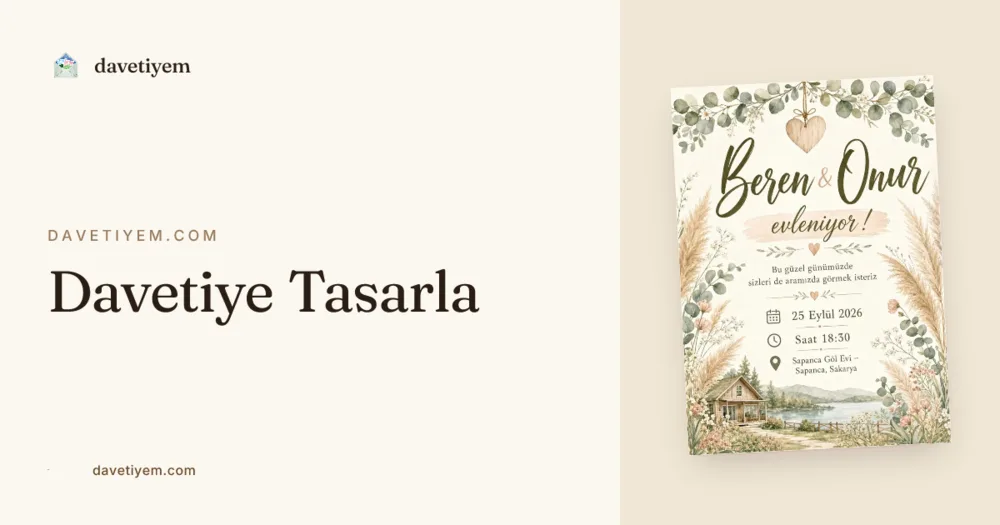
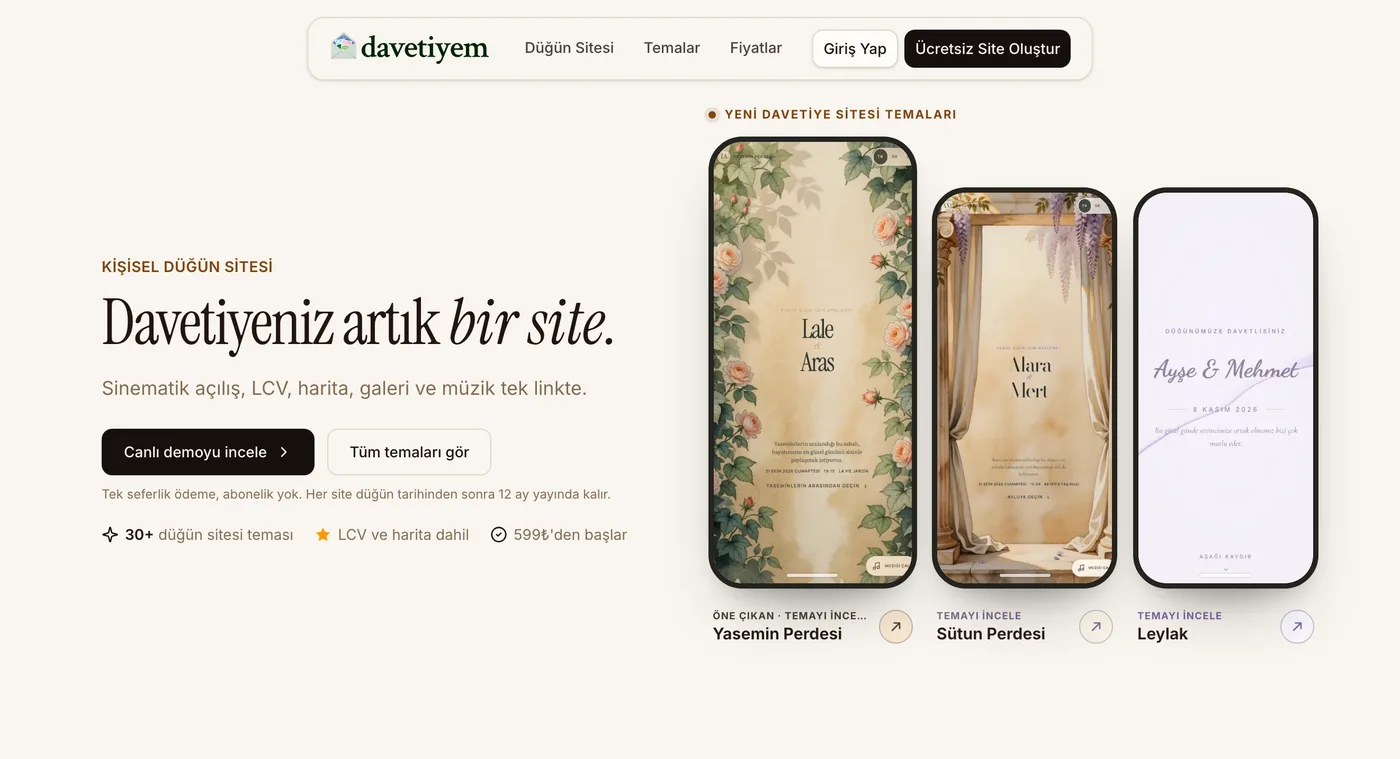
Today the product is a combination of an invitation editor, ready-made invitation and wedding website themes, RSVP tracking, venue and map information, photo galleries, music, one shareable link, one-time payment packages, and a free-to-start flow that introduces payment later.

Test 1: I tested the message
My first test was not an A/B test. It was more basic: I tested how to explain Davetiyem.
Wedding businesses often use similar phrases:
- Your most special day
- Your dream wedding
- Every moment matters
- We are happy to be with you
There is nothing inherently wrong with these sentences. They are just no longer distinctive.
If I described Davetiyem with the same language, I would not be explaining the product. I would simply be joining an existing category tone.
So I moved toward more concrete language:
- Create an invitation in five to ten minutes
- Describe the style you want
- Review and change drafts
- Share the invitation through a single link
- Use the invitation and wedding website together
The central idea became:
An invitation can be made quickly without being quickly forgotten.
I do not necessarily need to use this sentence as a product slogan. But it explains what the product is trying to solve.
Test 2: Starting for free
Asking for payment upfront is straightforward.
Choose a package, enter your information, pay, and start using the product.
But with a digital invitation, users usually want to see the result first.
How will the theme look? Will the names be placed correctly? Will the text fit the design? How will it look on a phone?
That is why I tested a free-to-start editing flow.
Users can experiment with the editor. Payment comes later, when they want to download or complete the invitation.
This has two advantages:
- Users can experience the product before paying.
- I can measure people who actually start creating an invitation, not just people who visit the website.
The important metrics are not only traffic:
- How many people open the editor?
- How many complete a draft?
- How many reach the download or sharing stage?
- How many pay?
- Where do users abandon the flow?

Test 3: SEO and search intent
I did not want Davetiyem to depend only on social media traffic.
The demand was already there. What mattered was that it arrives in different shapes:
- Inspiration. People browsing designs before they have decided anything.
- Wording. People who need the text that goes on an invitation, not a product.
- Tooling. People who want to make the invitation right now.
- Comparison. People weighing digital against printed, usually on price.
- Planning. People organising a wedding, of which the invitation is one task.
These are not the same visitor, and treating them as one was the mistake I wanted to avoid.
Someone looking for examples wants to browse. Someone comparing prices is closer to a purchase. Someone looking for wording may never buy anything, but they are the cheapest audience to reach and some of them come back later as buyers.
So I started building content and category pages around search intent rather than traffic alone.
Davetiyem includes:
- Invitation category pages
- Style pages
- Invitation wording pages
- Digital invitation guides
- Wedding website themes
- Free wedding planning tools
- Guest list and budget tools
The goal is not simply to bring someone from Google to the website. The goal is to create a natural transition between what they searched for and what the product does.

Google Search Console and Datafast
I use these tools to answer two different questions.
Google Search Console helps me understand how people find Davetiyem:
- Which queries generate impressions?
- Which pages generate clicks?
- Which pages have high impressions but low CTR?
- Is there a mismatch between the content and the search intent?
Datafast helps me understand what happens after the visit:
- Which channels bring traffic?
- Which pages receive the most visits?
- Where do users leave?
- Which devices are most common?
- Which sources bring visitors to product pages?

Reading these sources together matters.
A page can perform well in Search Console and still create no meaningful product action. A page with less traffic may be much more valuable if the visitors who arrive there start using the product.
So I am not only asking:
How many people visited?
I am also asking:
Did the right person arrive on the right page, and could they move forward?
What twelve months looked like
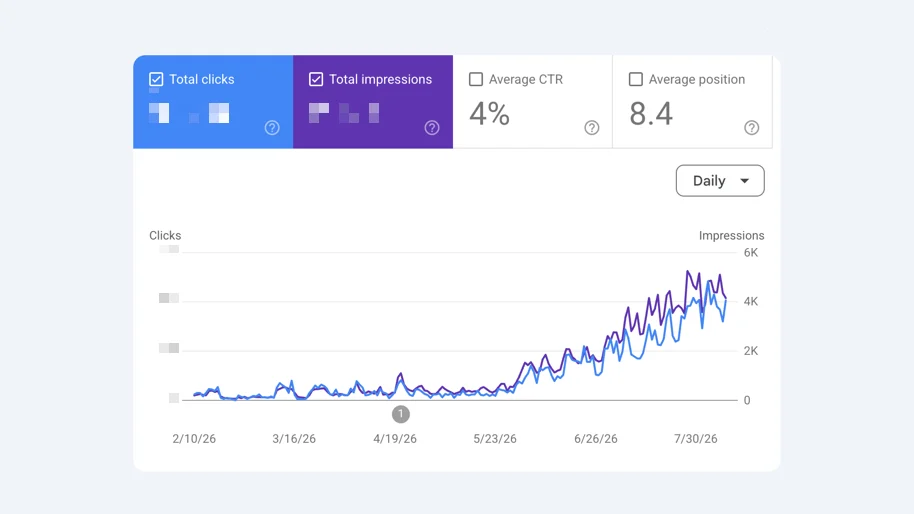
I am deliberately not publishing absolute traffic numbers or the queries I rank for. Competitors read posts like this one, and the specific keywords are the part of the work that took the longest. What I can show is the shape.
The chart below indexes organic clicks to the first month, so every value is a multiple of where I started rather than a raw figure.
Four things moved the line, and none of them were the thing I expected at the time.
1. The site became findable. For the first two months average position sat around 37, which in practice means nobody sees you. Fixing that was technical rather than creative, and it moved position into single digits almost immediately. Traffic barely moved. That is the part worth remembering: the fix that mattered most produced almost no visible result for months.
2. Content began to compound. Impressions roughly tripled while clicks only doubled. More people were seeing the site than were clicking it, which told me the pages were ranking for things they did not really answer.
3. Theme pages shipped. Giving each theme its own page turned one product into many entry points. This is where the intent split above stopped being a theory.
4. The inflection. Nine months of slow accumulation, then a month where clicks multiplied several times over and kept going. Nothing special happened in that month. It was the compounding of everything before it, which is the least satisfying and most honest explanation.
By month twelve the site was drawing roughly forty-six times the organic clicks of month one, at an average position that had improved from about 37 to about 8.
The milestones I have not filled in yet
The chart above is acquisition. It is not the business.
I am tracking a second timeline — first sale, first ten sales, the wedding-website launch, first repeat purchase — and I have deliberately left it out of this version rather than publish a number I have not verified. Traffic that does not convert is a hobby, and I would rather say that plainly than decorate the post with the half of the story that already looks good.
Test 4: Reducing friction instead of simply adding features
The changelog on Davetiyem reflects how the product has evolved.
In April, I worked on event-specific forms, photo-based invitations, and different wording options.
In May, I added invitation wording pages, pricing guides, and a digital invitation guide.
In June, I focused on onboarding and animated themes so new users could reach their first invitation faster.
In July, I added new wedding website themes, a theme gallery, free planning tools, a support assistant, and a drag-and-drop editor.
In August, I worked on cinematic themes, social sharing previews, clearer RSVP states, a free design flow, and reminders for unfinished projects.
These were not only feature additions.
Each one addressed a different point of friction:
- Users want to see the theme before they commit.
- Guest status needs to be easier to understand.
- Users may leave before finishing their design.
- A shared WhatsApp link should look good before it is opened.
- People planning a wedding need more than an invitation editor.
- The product should help users return to unfinished work.
Since I am building Davetiyem alone, I cannot build everything at once. Prioritization is part of the product.
Where Davetiyem is today
Today, Davetiyem includes:
- 36 wedding website themes
- An invitation editor
- A wedding website and invitation in one link
- RSVP tracking
- Maps, galleries, and music
- One-time pricing packages
- A free-to-start design flow
- SEO pages for invitations and wedding websites
- Wedding planning, budget, and guest list tools
- A roadmap shaped by user feedback
Throughout this process, I have tried to keep one idea intact:
An invitation can be created quickly without the result feeling careless.
What I have learned
1. The problem is not that people no longer want invitations
People still want invitations. The format is changing.
Printed invitations continue to make sense for people nearby. Digital invitations are becoming the practical way to reach everyone else.
My goal is not to eliminate printed invitations. It is to improve the digital half of the experience.
2. Users pay for the outcome, not the technology
AI, automation, and generation models can explain how a product works.
But the value for the user is simpler:
- I can describe the style I want.
- The names and text fit the design.
- The theme looks good.
- The invitation works on a phone.
- I can share it through one link.
- I can add a wedding website if I need one.
In marketing, explaining the outcome is usually more valuable than explaining the technology.
3. SEO and product are not separate activities
A search page brings someone in. A theme gallery explains the product. The editor activates the user. The payment page completes the conversion.
If one part of that chain is weak, the other parts become less effective.
I do not see SEO as only a content activity. SEO is the entrance to the product experience.
4. Solo product development requires discipline
I build Davetiyem alone.
That makes decisions faster, but it also means I have to control the scope constantly. I cannot build every idea I have.
When I consider a feature, I ask:
Does this make the product more useful, or is it simply interesting to build?
That question is not always comfortable, but it is necessary.
5. There are still unanswered questions
Where Davetiyem is today does not prove that the product works as a business. It shows the direction I am testing.
The questions I am still tracking include:
- Which package are users willing to pay for?
- How many free users complete their invitations?
- Which pages generate the strongest purchase intent?
- Is the wedding website or the invitation editor the stronger entry point?
- Do users use the product only once?
- How much can referrals and sharing contribute to acquisition?
- Is there a sustainable market for digital invitations in Turkey?
The answers will come from traffic, product usage, and revenue data together.
Conclusion
Davetiyem is not only a SaaS product for me. But I also do not want to explain it only through my family history.
I am not trying to recreate my family’s business online. I am testing how the same underlying need can be redesigned around changing user behavior.
Printed invitations are not disappearing. Digital invitations do not have to remain simple images sent through WhatsApp.
The idea I am testing is this:
Speed and care can exist in the same product.
I cannot say yet that Davetiyem will become the first name people think of for invitations in Turkey.
But I can say that I noticed a problem from inside an existing industry, turned it into a product hypothesis, built the product alone, started measuring acquisition and conversion, and continued making decisions based on evidence rather than assumptions.